Key Takeaways
- STEM education develops vital skills, including critical thinking, problem-solving, and technological fluency.
- Incorporating technologies such as artificial intelligence equips students for future innovation.
- Expanding STEM to STEAM by integrating the arts broadens creativity and adaptability.
- Encouraging diversity in STEM fields paves the way for more inclusive and innovative workplaces.
Table of Contents
- Developing Critical Thinking and Problem-Solving Skills
- Technological Literacy and Adaptation
- Integration of AI and Emerging Technologies
- Interdisciplinary Learning and STEAM Education
- Promoting Diversity and Inclusion in STEM
- The Role of Educators and Mentorship
- Conclusion
Science, Technology, Engineering, and Mathematics (STEM) education has become a driving force in preparing students for the challenges and opportunities of tomorrow’s workforce. By focusing on critical skills, hands-on experiences, and technological literacy, STEM programs set the stage for lifelong growth, innovation, and resilience. Not only does this educational path open doors to careers in fast-growing industries, but it also cultivates flexible thinkers able to solve complex, real-world problems. In many cases, fields like a STEM based military curriculum take these foundations even further, emphasizing discipline, teamwork, and adaptability alongside deep technical knowledge. As technology continues to evolve at breakneck speed, educators, parents, and policymakers are turning to STEM as a blueprint for future success.
But why does STEM education stand out? The answer lies in its multidisciplinary approach, the hands-on application of knowledge, and the push for inclusivity and diversity, vital ingredients in workplace innovation and societal progress. Students are no longer merely absorbing facts; they are taught to question, analyze, and develop skills that transcend the classroom and remain relevant well into their careers. The world’s most pressing challenges climate change, healthcare advancements, cybersecurity threats, and more require novel thinking and technological solutions. STEM empowers young people to rise to these challenges with clear-eyed confidence. This focus on STEM is shaping educational policies globally. For example, many public school systems and private institutions integrate STEM initiatives to boost competitiveness and adaptability in the global market. Yet, challenges persist, including disparities in access and the need for constant curriculum updates given the pace of change.
Additionally, collaborative efforts among schools, industries, and community organizations are spurring the development of innovative curricula and vocational pathways. These partnerships bridge the gap between academic theory and professional practice, further strengthening the argument for robust STEM learning environments.
Developing Critical Thinking and Problem-Solving Skills
Critical thinking forms the backbone of STEM. Students are taught not just to memorize but also to analyze data, understand patterns, and isolate key variables in complex problems. This approach transforms them into confident problem-solvers, well-equipped for dynamic industries such as finance, healthcare, and technology. By engaging with challenging scenarios (whether designing experiments or tackling open-ended questions), students gain experience that prepares them for complex, ever-changing workplace environments. Early exposure to STEM concepts boosts cognitive development, fostering inquisitive and innovative mindsets that are essential for future professionals.
Technological Literacy and Adaptation
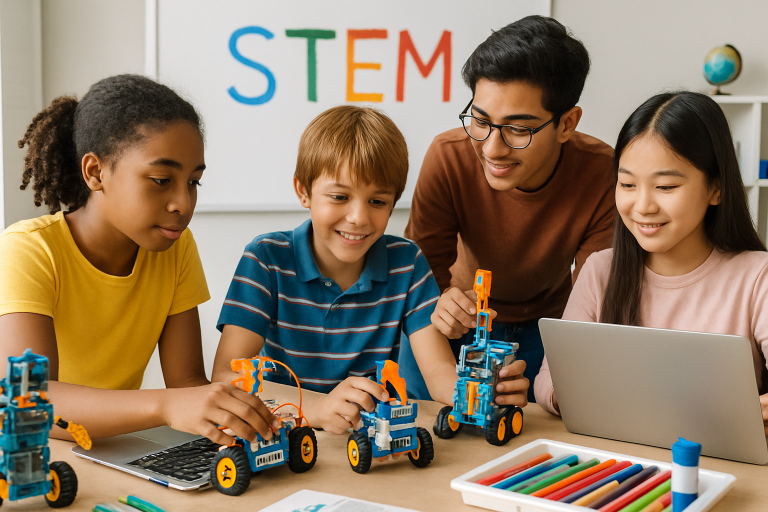
Today’s workplace demands fluency with emerging tools and platforms. STEM education demystifies technology by giving students hands-on experience with programming, digital fabrication, robotics, and advanced software. As technology continually evolves, adaptability is just as important as knowledge; effective STEM programs teach students not only the how but also the why behind each tool. This flexibility ensures that graduates aren’t left behind as innovations reshape industries. Increasing numbers of schools are integrating coding and basic AI into their curricula, recognizing that future opportunities will hinge on technological literacy.
Integration of AI and Emerging Technologies
Artificial intelligence is more than a buzzword it’s reshaping the workplace, education, and daily life. Recent surveys show educators and students recognize the importance of bringing AI competencies into the classroom. However, as a recent study highlights, while 96% of teachers believe AI will soon be crucial in education, 97% say they lack the resources to incorporate these technologies effectively. This underscores an urgent need for professional development and institutional support to realize AI’s potential in education fully. When properly integrated, AI and similar technologies empower students to tackle once-unimaginable problems, preparing them for jobs that may not yet exist.
Interdisciplinary Learning and STEAM Education
The evolution from STEM to STEAM where arts become a core component reflects an understanding that creativity drives innovation. Art and design principles can transform technical solutions, making them user-friendly and market-ready. Many schools now weave arts into traditional science and math courses, encouraging nuanced thinking and sparking new ways of problem-solving. Educators see STEAM as a way to nurture the whole student, blending logical reasoning with imagination and empathy. Such an approach is especially valued in industries like product design and communications, where innovation relies on both technical ability and creative vision.
Promoting Diversity and Inclusion in STEM
Innovation thrives in diverse environments. STEM fields have historically struggled with representation, but today there is a strong focus on ensuring students from all backgrounds have access to robust STEM learning. Initiatives and scholarships targeting underrepresented minorities and young women are gaining traction, providing not just educational support but also laying the groundwork for more equitable workplaces. Greater inclusion boosts creativity, broadens the talent pool, and delivers better outcomes for society as a whole. Today’s STEM classrooms, whether in city centers or through remote learning, are more inclusive than ever before, unlocking new possibilities for future leaders.
The Role of Educators and Mentorship
Guidance from dedicated educators and mentors can ignite lasting passion for science and technology. Programs like “Letters to a Pre-Scientist” connect students directly with working STEM professionals, offering mentorship, advice, and firsthand accounts of STEM careers. These connections humanize complex fields and allow students to envision themselves as future scientists, engineers, or mathematicians regardless of their background or initial confidence. Such mentorship expands students’ horizons and networks, making the transition from education to employment smoother and more informed.
Conclusion
STEM education equips students not just with knowledge but with the mindset to adapt and succeed in a fast-changing world. By cultivating critical thinking, technological fluency, and interdisciplinary creativity, while ensuring diversity and access, STEM is a powerful tool for both economic opportunity and social progress. The path to the future workforce requires adaptable, curious, and skilled problem-solvers qualities nurtured through every aspect of modern STEM education.