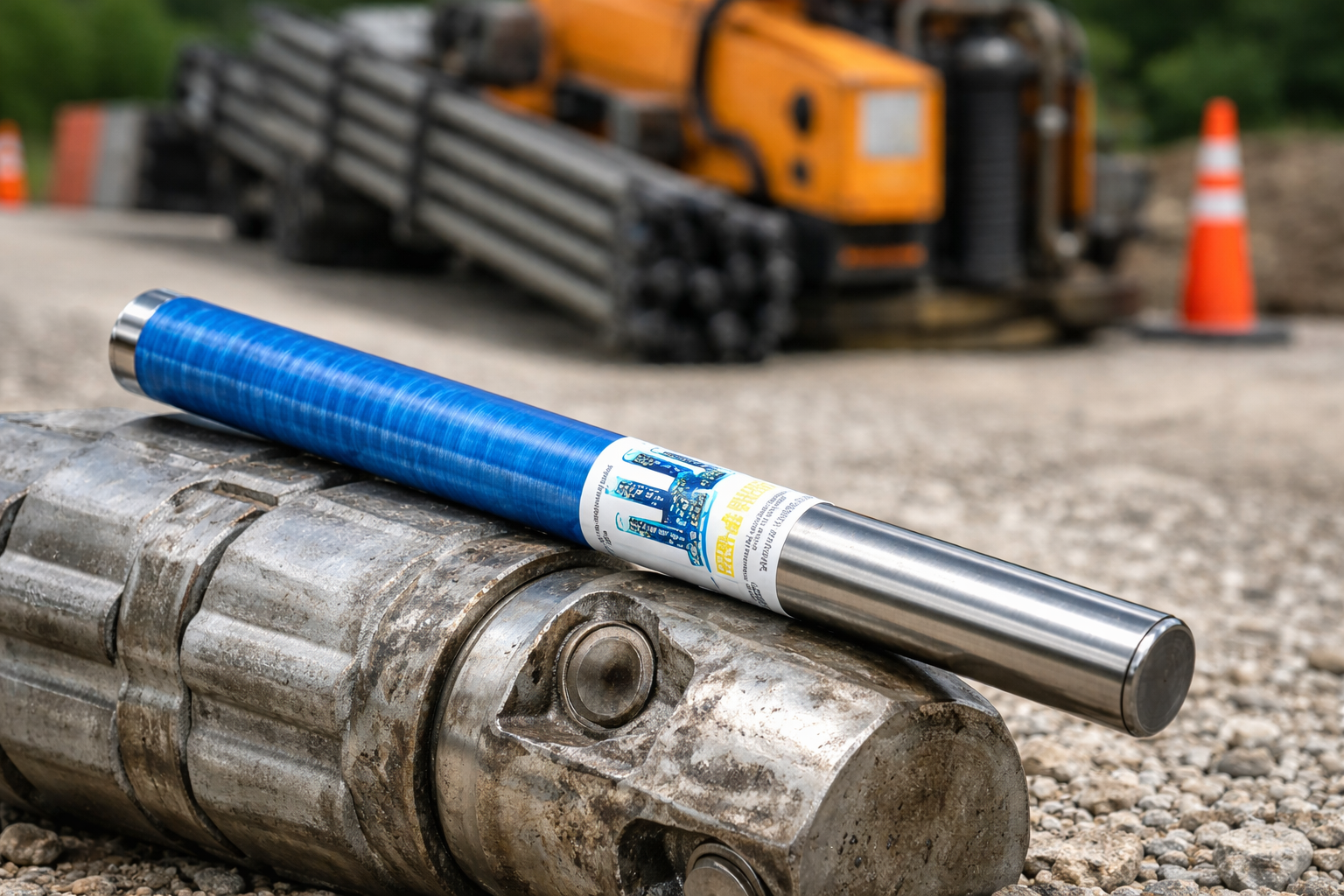
Choosing the right transmitter is not about finding the “best” one on paper. It is about matching the transmitter to the bore, the housing, the interference, and the data you need on that job.
That is where the DigiTrak 5XD 19/12 earns its place. In the classic F5 lineup, it sits in the practical middle. It gives you two selectable frequencies in one transmitter, stays in the standard 15-inch class, and fits the kind of work many HDD contractors want to cover with one dependable unit.
That does not make it the right answer for every job. Some jobs call for 1.3 kHz. Some call for fluid-pressure data. Some call for more range. Some call for a cable transmitter or a compact short-range unit. The smart comparison is not “Which transmitter is best?” It is “Which transmitter solves this problem?”
This guide looks at the DigiTrak 5XD 19/12 against other DigiTrak F5 transmitters and F5-compatible legacy F Series transmitters. The goal is simple: help you choose the transmitter that fits the work, the tooling, and the conditions you face in the field.
What the DigiTrak 5XD 19/12 Really Is
The first thing to clear up is the name. In the market, many sellers and buyers refer to this transmitter as the DigiTrak 5XD 19/12. In DigiTrak’s official documentation for the classic F5 platform, the naming used is F5D 19/12, along with related variants such as F5Dp/F5Dpx 19/12 and F5DLpx 19/12. In plain terms, when contractors say “5XD 19/12,” they are usually referring to the classic F5 19/12 transmitter family rather than a separate official model line.
That distinction matters because you want to compare the right products. The standard 15-inch 19/12 transmitter belongs to the classic F5 platform. It is not the same as a pressure transmitter, not the same as a 19-inch long-range model, and not the same as the newer Falcon F5 wideband family.
In the classic F5 lineup, the standard 15-inch 19/12 transmitter is listed with a 65 ft standard depth range, a 1.25 in. diameter, a 15 in. length, and a 220°F maximum temperature rating. It broadcasts at 19.2 kHz or 12.0 kHz. That gives it a simple, useful identity: a standard-size dual-frequency transmitter built for the classic F5 ecosystem.
Its value is not mystery. It is flexibility. You get two selectable frequencies in one transmitter body. For contractors who want one classic F5 transmitter that can cover a broad range of routine work, that is the main reason to look at it first.
Why the 19/12 Format Has Stayed Relevant
The 19/12 format has stayed relevant because it solves a common problem without becoming a specialty tool. A single-frequency transmitter can work well when conditions are stable and predictable. But the 19/12 gives crews another option when the site does not cooperate.
That is the practical advantage. The transmitter can operate at 19.2 kHz or 12.0 kHz, and DigiTrak’s F5 documentation says the frequency on a 19/12 transmitter can be changed after battery installation. DigiTrak also documents receiver menu shortcuts for changing the frequency of a 19/12 transmitter. That makes the transmitter more adaptable in the field than a model locked to one operating frequency.
The 19/12 format also stays in the familiar 15-inch class. DigiTrak notes that the newer mechanical design remains compatible with housings that accept 15 in. DigiTrak transmitters, though some housings may require a different tooling adapter. That matters for crews trying to stay with a standard classic F5 setup instead of changing housings, batteries, and operating habits at the same time.
Put simply, the 19/12 has stayed relevant because it covers the broad middle of classic F5 work. It is not the deepest-range transmitter. It is not the compact option. It is not the cable-powered option. It is the balanced dual-frequency option. For many contractors, that is exactly what makes it useful.
5XD 19/12 vs F5 12/1.3 and Single-Frequency F5 Transmitters
The most useful comparison starts inside the classic F5 family. That means looking first at the F5 12/1.3 dual-frequency transmitter and the single-frequency F5X models.
The F5 12/1.3 looks close to the 19/12 at first glance. It is also a 15 x 1.25 in. classic F5 transmitter with a 65 ft standard depth range and a 220°F maximum temperature. But it serves a different need. The 19/12 runs at 19.2 kHz or 12.0 kHz. The 12/1.3 runs at 12.0 kHz or 1.3 kHz. DigiTrak’s documentation also says the 12/1.3 family can broadcast simultaneously in 12 kHz and 1.3 kHz or at higher power in 12 kHz alone. That is not the same operating profile as the 19/12.
The single-frequency F5X 18 and F5X 8 are simpler still. They are also 15 x 1.25 in. transmitters with a 65 ft standard depth range and a 220°F temperature rating. But they run at one frequency only: 18.5 kHz for the F5X 18 and 8.4 kHz for the F5X 8.
This is where the 5XD 19/12 stands apart. It is not trying to be the low-frequency 1.3 kHz tool, and it is not limited to one frequency. It sits between those two extremes. That makes it the better fit when the contractor wants one classic F5 transmitter that can handle a wider range of conditions without moving into a more specialized category.
When the 19/12 Is a Better Fit Than the 12/1.3
The 12/1.3 transmitter is not a weaker version of the 19/12. It is a different solution. The reason to choose it is clear: you need access to 1.3 kHz. If that is the requirement, the 12/1.3 belongs in the conversation immediately.
But if the goal is broad usefulness inside the classic F5 platform, the 19/12 often makes the cleaner choice. It gives the operator two selectable frequencies, stays in the standard 15-inch class, and uses the same familiar format as other standard F5 transmitters. DigiTrak’s F5 documentation also makes an important distinction between the two dual-frequency families: 19/12 transmitters can have frequency changed after batteries are installed, while 12/1.3 transmitters must be set during battery installation. That difference matters in the field because it affects how easily the crew can adapt once the job is underway.
The 19/12 is therefore the stronger “general-purpose” option within the classic F5 family. It does not offer 1.3 kHz, and it does not claim to. Its strength is that it gives you a dual-frequency setup without pushing you into a more specialized operating case.
For contractors trying to cover routine HDD work with one dependable classic F5 transmitter, that balance is hard to ignore. The 19/12 does not win by doing everything. It wins by doing the middle of the market well.
When a Single-Frequency F5X Model Makes More Sense
Single-frequency transmitters still have a place. A transmitter like the F5X 18 or F5X 8 can be a sensible choice when the operating conditions are known and the contractor wants a straightforward setup.
The numbers make the comparison clear. The F5X 18 and F5X 8 share the same 15 x 1.25 in. form factor, the same 65 ft standard depth range, and the same 220°F maximum temperature as the standard 19/12 family. The difference is flexibility. A single-frequency transmitter gives you one band and no second option.
That can be perfectly acceptable when the work is consistent and the crew already knows which frequency best suits the job. A simple setup has its own value. It reduces decisions and can make transmitter selection easy.
But the limitation appears as soon as the site favors another frequency. At that point, the single-frequency transmitter cannot adapt. The 19/12 can. That is the real advantage of the 5XD 19/12 over the F5X models. Not that it is always better, but that it gives the operator another path without changing to another transmitter.
If the buyer wants the simplest possible classic F5 transmitter and knows one frequency is enough, an F5X model may be the right answer. If the buyer wants a wider operating envelope in the same standard size, the 19/12 is the stronger choice.
Pressure Models and Long-Range Models: Where the 5XD 19/12 Stops
A good comparison depends on knowing where one product category ends and another begins. The standard 5XD 19/12 is a classic F5 dual-frequency transmitter. It is not a fluid-pressure transmitter, and it is not the longest-range option in the F5 family.
That matters because the classic F5 lineup includes transmitters built for those specific needs. DigiTrak lists pressure-capable models such as the F5Dp/F5Dpx 19/12 and the F5DLpx 19/12. These are not minor variations. They add fluid-pressure capability to the locating system. DigiTrak’s F5 transmitter spec sheet lists the fluid-pressure range as 0 to 250 psi, with 1 psi resolution from 0–75 psi and 5 psi resolution from 75–250 psi. The same sheet also says fluid-pressure data is not sent while the transmitter is in XRange mode.
Range is another dividing line. The standard 15-inch F5D 19/12 is listed at 65 ft standard depth/data range. By contrast, the 19-inch F5DLpx 19/12 is listed at 100 ft standard depth/data range, with even greater data range in XR and XR Max operation.
This is the clean way to think about the category. The 5XD 19/12 covers the standard dual-frequency role. When the job requires pressure data or more reach, the comparison shifts from “Which standard transmitter should I buy?” to “Do I need a specialty transmitter instead?”
Standard 19/12 vs Pressure-Enabled F5 Transmitters
Pressure capability changes the buying decision immediately. If the bore requires pressure data, a standard 19/12 transmitter is not enough, no matter how useful its dual-frequency setup may be.
In the classic F5 line, the pressure-enabled options include the F5Dp/F5Dpx 19/12 and the F5DLpx 19/12. DigiTrak lists their fluid-pressure capability at 0 to 250 psi. That makes them the right comparison when the contractor needs more than standard locate data. Pressure information serves a different purpose from frequency flexibility. It is not an extra convenience. It is a different operating requirement.
The trade-off is simple. If the job does not require pressure monitoring, the standard 5XD 19/12 remains the cleaner, more general-purpose choice. It covers standard locating work in the familiar 15-inch F5 format without adding features the crew may not use. But once pressure information becomes important, the pressure-capable transmitters move to the front of the line.
This is why the standard 19/12 should not be judged against pressure models as if they were trying to do the same thing. They are not. One is a dual-frequency locating transmitter. The others are dual-frequency locating transmitters that also add pressure data. The right one depends on what the job demands.
Standard 15-Inch 19/12 vs 19-Inch Long-Range F5 Models
Range is the other point where the standard 5XD 19/12 gives way to a more specialized option. The standard 15-inch F5D 19/12 is listed with a 65 ft standard depth/data range. That puts it in the standard working class for the classic F5 platform.
The 19-inch F5DLpx 19/12 sits in a different class. DigiTrak lists it at 100 ft standard depth/data range, with 170/200 ft XR/XR Max data range. That is a meaningful jump. It exists because some jobs ask more of the transmitter.
But the larger transmitter brings its own requirements. DigiTrak notes that the 19-inch unit should use SuperCell or SAFT batteries, and that alkaline batteries are not recommended because of the higher power demands. That alone tells you that the 19-inch model is not just a longer version of the same tool. It is a more specialized one.
The buying decision is straightforward. If the contractor wants a versatile classic F5 transmitter that fits the standard 15-inch class and covers general work, the 5XD 19/12 remains the stronger fit. If the contractor knows the job requires more depth and data range, the 19-inch long-range class becomes the better answer. The larger transmitter earns its place when range, not general flexibility, is the main concern.
How the 5XD 19/12 Compares With Legacy F Series Transmitters
The classic F5 platform does not stand alone. DigiTrak says the F5 system is compatible with all F Series transmitters, including FX long range, FXL extended range, FC cable, and FS short range. The F5 operator’s manual also lists FX 12, FX 19, FXL 12, FXL 19, FC, and FS in the transmitter selection menu.
That matters because many contractors shopping for replacement or backup equipment are not comparing only transmitters labeled “F5.” They are comparing any transmitter the F5 receiver can run.
The simplest legacy comparison is with the FX 12 and FX 19. DigiTrak lists both as 15 x 1.25 in. transmitters with a 65 ft depth range. But each is single-frequency. One runs at 12 kHz and the other at 19.2 kHz. Against them, the 5XD 19/12 offers the obvious benefit of two selectable frequencies in a similar standard-size package.
The FXL 12 and FXL 19 go in another direction. DigiTrak lists them as 19-inch extended-range transmitters with an 85 ft depth range. They are range-first tools, not dual-frequency tools. The FC cable transmitter is another special case: DigiTrak lists it as 19 x 1.25 in., 12 kHz, 90 ft depth range, and powered by 9–28 VDC cable power. The FS is the compact end of the lineup: 8 x 1.0 in., 12 kHz, and 15 ft depth range.
This keeps the comparison honest. The 5XD 19/12 competes most directly with standard-size legacy transmitters. Once you move into extended-range, cable-powered, or short-range tools, you are solving a different problem.
5XD 19/12 vs FX and FXL Models
The FX and FXL models are the legacy transmitters most likely to come up in a practical buying decision. They are F5-compatible, but they serve different purposes.
The FX 12 and FX 19 are the closest direct legacy comparison to the 5XD 19/12. They match the standard 15 x 1.25 in. class and the 65 ft depth range. The difference is frequency choice. An FX 12 gives you 12 kHz. An FX 19 gives you 19.2 kHz. The 5XD 19/12 gives you both selectable frequencies in one transmitter. That is the key advantage. It gives the contractor more flexibility without asking for a change in the standard size category.
The FXL 12 and FXL 19 are not direct substitutes in the same way. DigiTrak lists them as 19-inch extended-range transmitters with an 85 ft depth range, and says they require a SuperCell lithium battery. DigiTrak also notes a housing requirement: best signal emission and battery life depend on housings with 13 in. slots beginning 2 in. from the front/index end. That tells you the FXL family is not just a range upgrade. It is a more specific setup.
That is why the 5XD 19/12 often lands in the practical middle. It gives the buyer more flexibility than an FX model without moving into the more specialized FXL class.
Where FC and FS Fit in the Comparison
The FC and FS models belong in the comparison because they define the edges of the F5-compatible transmitter family.
The FC cable transmitter is a specialty tool. DigiTrak lists it at 19 x 1.25 in., 12 kHz, with a 90 ft depth range, powered by 9–28 VDC cable power, and rated to 180°F. Those details put it in a separate operating category from a standard battery sonde like the 5XD 19/12. It is not a general substitute for a standard dual-frequency F5 transmitter. It is a transmitter for a specific application.
The FS short-range transmitter sits at the other end of the scale. DigiTrak lists it at 8 x 1.0 in., 12 kHz, 15 ft depth range, powered by one AA alkaline battery, and rated to 180°F. That makes it a compact, shallow-range tool, not a direct competitor to the standard 15-inch 19/12.
These models are useful in the comparison because they prevent bad assumptions. Not every transmitter that works with an F5 receiver should be compared as if it fills the same role. The FC and FS do not. They are purpose-built transmitters for narrower tasks. The 5XD 19/12 remains the standard dual-frequency option for contractors who want a classic F5 transmitter that covers general work in the familiar 15-inch class.
How to Choose the Right DigiTrak F5 Transmitter for the Job
A sound buying decision starts with the job. Not the label. Not the catalog. The job.
If the contractor wants one versatile transmitter in the classic F5 family, the 5XD 19/12 makes a strong case. It gives you 19.2 kHz or 12.0 kHz in one transmitter, stays in the standard 15 x 1.25 in. format, and carries a 65 ft standard depth range. For many crews, that is the practical center of the market.
If the work specifically calls for 1.3 kHz, then the F5 12/1.3 becomes the right comparison. If the job requires fluid-pressure monitoring, move to a pressure-capable F5 transmitter. If the work requires more depth and data range, look at the 19-inch long-range category. If the crew knows one frequency is enough and wants a simpler setup, a single-frequency F5X or legacy FX model may be sufficient.
Compatibility matters too. DigiTrak says the newer mechanical design of the standard F5 15-inch transmitters remains compatible with housings that accept 15 in. DigiTrak transmitters, though a different tooling adapter may be needed. Once you move into 19-inch models or specialty transmitters, those fit and battery details matter more.
The simplest buying rule is this: choose the transmitter for the work you actually do. The 5XD 19/12 is often the right answer because it balances flexibility, familiarity, and standard F5 fit. The moment the job calls for pressure data, extra range, cable power, or short-range compact size, a different transmitter becomes the better tool.
Quick Comparison Table
| Transmitter Type | Main Frequencies | Typical Format | Standard Depth Range | Best Fit |
| DigiTrak 5XD / F5D 19/12 | 19.2 kHz / 12 kHz | 15 in. x 1.25 in. | 65 ft | General-purpose classic F5 work with dual-frequency flexibility |
| F5 12/1.3 | 12 kHz / 1.3 kHz | 15 in. x 1.25 in. | 65 ft | Jobs that specifically need 1.3 kHz access |
| F5X 18 | 18.5 kHz | 15 in. x 1.25 in. | 65 ft | Single-frequency work where one known band fits the job |
| F5X 8 | 8.4 kHz | 15 in. x 1.25 in. | 65 ft | Single-frequency work where one known band fits the job |
| F5Dp / F5Dpx 19/12 | 19.2 kHz / 12 kHz | 15 in. x 1.25 in. | 65 ft | Dual-frequency locating plus fluid-pressure capability |
| F5DLpx 19/12 | 19.2 kHz / 12 kHz | 19 in. x 1.25 in. | 100 ft | Long-range work with fluid-pressure capability |
| FX 12 / FX 19 | 12 kHz or 19.2 kHz | 15 in. x 1.25 in. | 65 ft | Legacy single-frequency replacement use |
| FXL 12 / FXL 19 | 12 kHz or 19.2 kHz | 19 in. x 1.25 in. | 85 ft | Legacy extended-range applications |
| FC Cable | 12 kHz | 19 in. x 1.25 in. | 90 ft | Cable-powered specialty locating applications |
| FS Short-Range | 12 kHz | 8 in. x 1.0 in. | 15 ft | Compact, shallow-range specialty work |
Why This Comparison Matters When You Are Buying Used, Refurbished, or Replacement Equipment
In the field, transmitter buying is usually practical. Contractors are trying to keep equipment working, match a housing, solve an interference problem, or replace a failed unit without buying the wrong thing.
That is why the comparison matters. On paper, many DigiTrak F5-compatible transmitters can look close. In practice, the details decide the outcome. Length matters. Frequency options matter. Pressure capability matters. Standard range versus extended range matters. Battery requirements matter. Housing fit matters.
The 5XD 19/12 is a strong option because it covers the standard dual-frequency role so well. It gives many contractors what they need most: one classic F5 transmitter that stays in the standard size class and offers two selectable frequencies. But it should not be forced into jobs that clearly call for something else. If the work points to 1.3 kHz, a pressure model, a 19-inch long-range unit, a cable transmitter, or a compact short-range transmitter, those categories exist for a reason.
That is where a good supplier earns trust. Not by pushing every buyer toward the newest or most specialized option, but by helping match the transmitter to the real job. For contractors working through replacement, backup, or inventory decisions, that kind of guidance saves time and cuts mistakes.
At UCG HDD, that is the practical value. The goal is to help contractors sort through the classic F5 options, identify the transmitter that fits their tooling and job demands, and get back to work with less guesswork.