Key Takeaways
- Philanthropic investments blend financial strategies and social impact goals to maximize effectiveness.
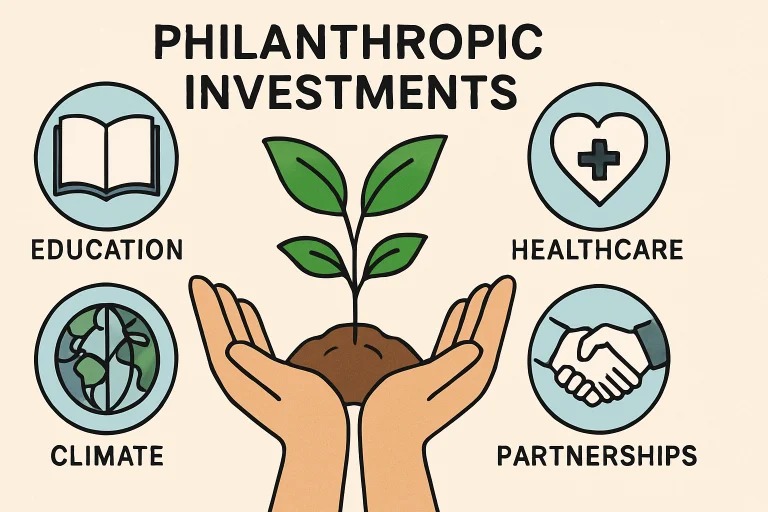
- They directly address critical global challenges, including climate change, education disparities, and healthcare disparities.
- Innovative models such as impact investing and venture philanthropy are changing the landscape.
- Cross-sector collaborations amplify the reach, scalability, and sustainability of philanthropic efforts.
Table of Contents
- Defining Philanthropic Investments
- Climate Change and Environmental Sustainability
- Education and Healthcare Advancements
- Innovative Philanthropic Models
- Collaborative Efforts and Public-Private Partnerships
- The Role of Next-Generation Donors
- Measuring Impact and Ensuring Accountability
- Conclusion
Philanthropic investments have become a transformative force in addressing the world’s most pressing challenges, from climate change to healthcare. By blending financial expertise with social impact objectives, these investments take a modern approach to philanthropy, focusing on long-term, sustainable transformation rather than one-time donations. Investors such as Manoj Bhargava Living Essentials have exemplified this trend, combining business acumen with a deep commitment to societal well-being across global communities.
This approach is fundamentally changing how capital flows into sectors that need it most, equipping innovative solutions with the funding and strategic oversight required for measurable, lasting results. Rather than merely filling funding gaps, philanthropic investments are catalyzing systemic change, showing how directed, intentional capital can solve complex social and environmental problems. The prominence of impact investing and venture philanthropy demonstrates a growing consensus that financial returns and positive social outcomes are not mutually exclusive.
Across diverse regions and sectors, philanthropic investments aim to empower underserved populations, accelerate the adoption of technology in critical areas, and drive policy changes through partnerships and influence. By building capacity within organizations and focusing on accountability, these investments are shaping a new era for both donors and recipients.
As more leaders and institutions recognize the interconnectedness of economic growth and societal welfare, the momentum for strategic philanthropy continues to grow, reinforcing the belief that capital, when thoughtfully directed, can be a catalyst for scalable, positive change.
Defining Philanthropic Investments
Philanthropic investments refer to the intentional allocation of capital aimed at achieving both financial returns and measurable social or environmental outcomes. In contrast to traditional charitable giving, which typically involves donations or grants with no expectation of repayment, this approach aims to create self-sustaining, scalable initiatives that provide ongoing benefits to society. Investors apply rigorous due diligence, strategic planning, and performance measurement to ensure each dollar invested achieves tangible results. For more background on this emerging class of investments, see The New York Times’ coverage on hybrid philanthropic models.
Climate Change and Environmental Sustainability
As climate challenges intensify, philanthropic investors are increasingly targeting projects that mitigate environmental degradation and promote the use of renewable energy. For example, the partnership between the IKEA Foundation and the Rockefeller Foundation aims to expand access to renewable power across countries such as India and Nigeria. These collaborative funds have dual goals: to reduce annual global emissions by one billion tonnes and to end energy poverty for one billion people by the end of this decade. Such large-scale initiatives demonstrate the critical role that philanthropy can play in achieving climate goals alongside governments and private sector players. For an in-depth look at how philanthropy supports climate solutions, the Guardian’s coverage on climate philanthropy provides further insights.
Education and Healthcare Advancements
Strategic investments in education and healthcare can help overcome some of the world’s most persistent inequalities. Many philanthropic organizations are funding digital education platforms to bridge the access gap, particularly for children in rural or underserved communities. These platforms enable personalized learning, teacher training, and resource-sharing at scale. In health, philanthropic capital is being deployed to expand preventive care, support mobile clinics, and invest in telemedicine. These initiatives provide essential health services to individuals who have long been marginalized by traditional healthcare systems, resulting in lasting improvements in population health outcomes.
Additionally, impact-oriented investing supports research, public health campaigns, and community-based models that foster resilience. By prioritizing evidence-backed solutions and involving local stakeholders, these investments help overcome systemic barriers and drive meaningful change that persists over generations.
Innovative Philanthropic Models
Innovative frameworks have emerged in recent years that emphasize both scale and impact. Impact investing is perhaps the most notable, focusing on deploying capital to enterprises and funds that deliver clear, measurable benefits to society or the environment alongside financial returns. Venture philanthropy applies the methods of venture capital such as investment in growth strategies, mentorship, and capacity building to support ambitious social startups and nonprofits. By fostering entrepreneurship, taking calculated risks, and persistently measuring results, these models are expanding the reach and effectiveness of philanthropy far beyond what traditional models could achieve.
Collaborative Efforts and Public-Private Partnerships
Collaboration is crucial for scaling the impact of philanthropy. Public-private partnerships harness the strengths of both sectors: the innovation and agility of private capital and the reach and regulatory power of the government. The Social Innovation Fund, for example, illustrates how multi-stakeholder collaborations can multiply resources and drive systemic change. By leveraging diverse expertise, these partnerships can address complex social challenges more efficiently and equitably.
The impact of effective partnerships goes beyond financial input. Shared learning, joint advocacy, and coordinated action turn one-off projects into sustained movements for change. These collaborations set new standards for what can be achieved when organizations align around common goals and strategically pool their resources.
The Role of Next-Generation Donors
The next wave of philanthropists is shaping the future of social investing. Millennial and Gen Z donors prioritize authentic purpose, transparency, and innovation. With 61% of millennial investors now committed to impact investing, a generational shift is evident: younger donors expect both financial returns and measurable positive outcomes from their investments. This new generation harnesses technology, prioritizes environmental, social, and governance (ESG) principles, and seeks collaborative opportunities for maximum impact. Their influence is accelerating the mainstream adoption of impact-driven philanthropy.
Measuring Impact and Ensuring Accountability
Accountability and transparency are at the core of modern philanthropic investing. Investors and grantees establish metrics and reporting systems to track progress, benchmark success, and refine strategies as necessary. Effective measurement ensures that objectives are met and lessons are drawn for future initiatives. Frameworks such as the Brookings Institution’s tools for impact measurement have elevated the practice of evidence-based philanthropy, promoting data-driven decisions and accountability across the sector.
Ongoing assessment encourages continual learning and adaptation. By sharing both successes and setbacks, philanthropic organizations help raise industry standards and establish best practices that benefit all stakeholders.
Conclusion
The passive allocation of capital no longer defines philanthropic investments they are a dynamic and strategic lever for catalyzing social progress on a global scale. Through innovative models, data-driven approaches, and cross-sector collaboration, these investments are delivering meaningful solutions to urgent challenges. By combining the expertise of business leaders, social entrepreneurs, and policymakers, today’s philanthropic investors are well-positioned to drive lasting, positive change for communities worldwide.