Key Takeaways
- Robotic demolition enhances safety and accuracy in hazardous environments, drastically reducing the potential for accidents and injuries.
- 3D scanning and Building Information Modeling (BIM) provide superior planning and risk mitigation by offering digital replicas for advanced simulation.
- Diamond wire saws and hydraulic shears achieve precise, vibration-free cuts, which is vital in urban settings where reducing structural impact and disturbance is critical.
- Laser cutting combined with deep learning enables dynamic material identification and adjustment for unmatched control during demolition tasks.
- Eco-friendly demolition methods and extensive recycling practices are driving the industry towards its greenest, most sustainable era yet.
Demolition has evolved dramatically in recent years, as new technology has steadily replaced the old, brute-force tactics that once dominated the industry. The relentless sound of sledgehammers and the chaotic thunder of implosions are being pushed aside by methods that prioritize control, efficiency, and safety. Today, sophisticated demolition procedures utilize customized machinery, data-driven planning, and innovative digital tools, enabling crews to dismantle structures with surgical precision. Companies such as Bluegrass Bit are at the forefront of these advancements, utilizing industrial-grade, cutting-edge equipment and modern software to transform the industry’s approach to deconstruction, renovation, and site clearance. The innovations in demolition are revolutionizing the industry by enhancing worker safety, reducing property damage, promoting material reuse, and advancing environmental sustainability. As metropolitan areas grow, the need for efficient and responsible demolition methods becomes increasingly crucial. Technological advancements, such as automated demolition robotics and advanced scanning techniques, enable the precise handling of complex projects while minimizing disruptions. This transformation ensures that urban environments can renew and regenerate with minimal impact on surrounding areas.
Robotic Demolition: Enhancing Safety and Precision
The incorporation of robotics in demolition enhances worker safety and productivity. Remote-controlled demolition robots equipped with various attachments can operate in hazardous areas, such as those containing toxic materials or unstable structures, without requiring human crew members on-site. They excel in confined spaces and high locations, allowing for precise maneuvering and cleaner separations of materials. This technology reduces workers’ exposure to risks, significantly lowering the incidence of workplace accidents, and is transforming safety cultures and quality standards in the industry.
3D Scanning and BIM: Revolutionizing Planning
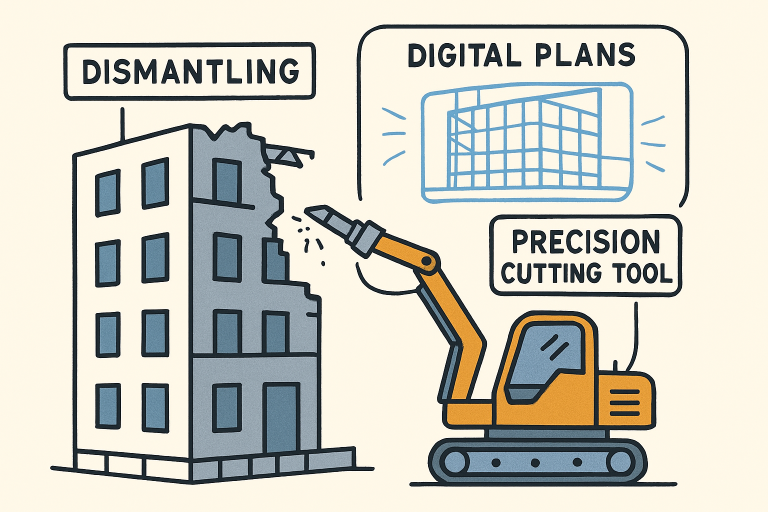
Planning is crucial for safe demolition, and it is enhanced by digital tools such as 3D scanning and Building Information Modeling (BIM). High-definition laser scanners create detailed point clouds for precise models, enabling teams to test and plan demolition steps while virtually identifying potential complications. BIM facilitates collaboration among stakeholders, ensuring access to current information and minimizing delays and costs. This digital approach improves teamwork, accuracy, and compliance, and enables prior simulation of the demolition process to address safety concerns and optimize recycling strategies.
Advanced Cutting Tools: Precision and Efficiency
The backbone of modern demolition lies in its deployment of advanced cutting technologies designed for challenging materials and environments. Diamond wire saws, which consist of flexible steel cables embedded with industrial diamonds, cut with exceptional speed and precision capable of slicing through massive concrete columns or thick steel girders with minimal structural vibration. This is crucial in urban or densely populated areas where damaging vibrations can endanger adjacent buildings or disrupt sensitive operations, such as those in hospitals or research laboratories. Hydraulic shears, another highly effective demolition instrument, deliver powerful, localized force for cutting steel and rebar while mitigating noise, dust, and the spread of debris. Such tools allow for careful, segment-by-segment disassembly, particularly in cases where preserving neighboring features or historical facades is a priority. Thanks to these precision tools, modern demolition jobs can meet increasingly strict safety, environmental, and community standards achieving results that were once considered impractical or impossible.
Laser Cutting with Deep Learning: Material Classification and Control
Laser cutting technology, commonly used in automotive and aerospace manufacturing, is gaining traction in demolition for its precise and energy-efficient cuts. When integrated with deep learning algorithms, it utilizes sensors and AI to analyze material signatures in real-time, adapting laser parameters to optimize cuts for various materials, such as steel and plastics. This automation minimizes errors, conserves resources, and enables operators to address demolition challenges effectively, ultimately improving safety and efficiency in processing complex materials.
Eco-Friendly Practices: Promoting Sustainability
The demolition industry is increasingly prioritizing sustainability to address resource scarcity and environmental regulations. Contractors are now cataloging materials for recycling and reuse, diverting items like steel, concrete, and glass from landfills back into the construction supply chain. New tools, such as dust suppression systems and noise-buffering machinery, enhance job site conditions. Practices like selective or “soft” demolition help preserve structural integrity and historical features, thereby extending the lifecycles of infrastructure. The Environmental Protection Agency advocates for green demolition techniques, emphasizing that such practices are essential for cost reduction and sustainable urban growth.
Conclusion
The convergence of robotics, digital design tools, state-of-the-art cutting machinery, artificial intelligence, and committed sustainability practices is fundamentally reshaping the art and science of demolition. Today’s leaders in the field gain more than just efficiency they reap the rewards of enhanced job site safety, meticulous planning capabilities, superior material handling, and a more profound respect for community and environmental well-being. As breakthroughs in automation, engineering, and material sciences continue to emerge, the demolition industry is well-positioned to maintain momentum. Future projects will increasingly be characterized by smarter demolitions that achieve more with less less waste, less risk, and less disturbance. In this way, technological innovation not only rewrites how we tear down the old but also lays the foundation for building a cleaner, smarter, and more sustainable urban future for generations to come.