In the expansive world of 3D design, the most common mistake beginners make isn’t related to aesthetics; it’s related to measurement. A model that looks perfect on a screen can be useless in a game engine or a 3D printer if its scale and specifications are incorrect. As we move into 2026, the rise of standardized 3D design tools is finally bridging this gap, allowing even those without a background in geometry to produce professional-grade assets with perfect real-world proportions.
The “Scale Gap” in Early 3D Modeling:
🔹 Models appearing too small or too large when imported into AR environments.
🔹 “Broken” geometry that fails to print because the mesh isn’t watertight.
🔹 Texture stretching caused by inconsistent UV mapping and resolution.
Precision Through Native Volumetric Logic
The secret to a perfect 3D asset lies in how it perceives volume. Modern platforms like Neural4D utilize the Direct3D-S2 architecture to ensure that every reconstruction adheres to native volumetric logic. By analyzing a single 2D image, the system employs Spatial Sparse Attention (SSA) to reconstruct a 3D form that respects the mathematical proportions of the original object.
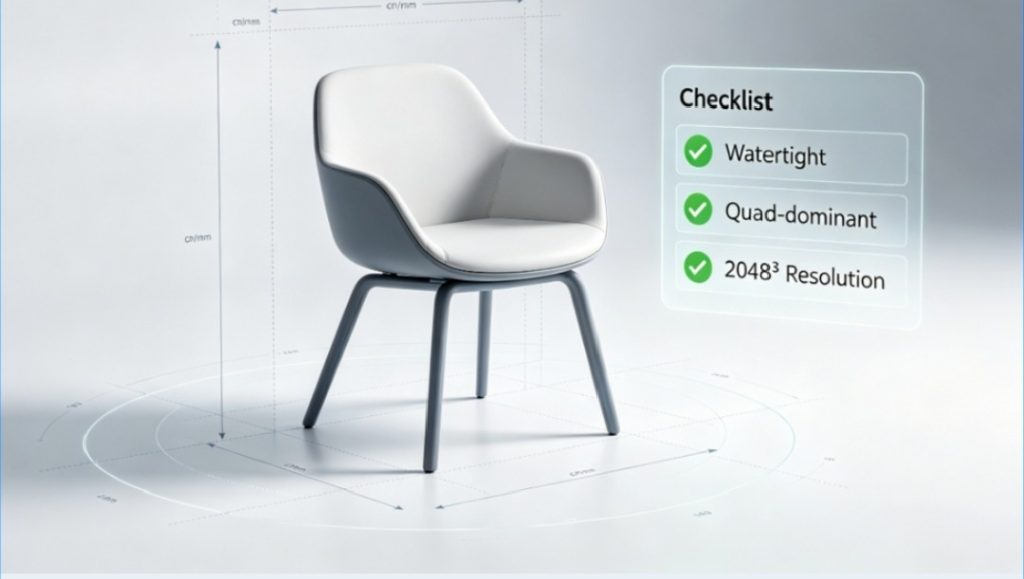
This results in an asset with a native 2048³ resolution, providing a level of detail that meets industrial standards. For hobbyists and businesses alike, this means the end of manual scaling and the beginning of deterministic, high-fidelity production.
Standardized Output Benchmarks:
✅ Quad-dominant topology: Ensures the mesh is optimized for real-time rendering without lag.
✅ Watertight geometry: Guaranteed closed volumes that are 100% ready for 3D printing.
✅ 12x Inference Speed: Massive efficiency gains, allowing for rapid iteration of multiple size variations.
Why “Watertight” is the Gold Standard
In the context of 3D specifications, a “watertight” mesh is non-negotiable. It means the model has zero non-manifold edges; no holes or overlapping faces that would cause a software crash. Neural4D automates this complex geometric requirement, ensuring that the final file is “engine-ready” for platforms like Unity or Unreal Engine the moment it is generated.
By integrating standardized AI logic into your workflow, you eliminate the “technical debt” of manual cleanup. Whether you are designing furniture for a digital catalog or creating characters for a new game, the focus can stay on creativity while the AI handles the rigid requirements of digital physics and scale.