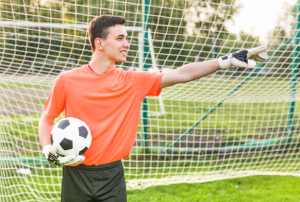
In football analytics, goalkeepers serve as the statistical outliers—defined by prevention rather than creation. During the 2019/2020 Bundesliga season, the divide between elite and struggling goalkeepers widened more than metrics initially showed. While attackers convert potential into goals, goalkeepers reverse probability. Understanding their form patterns reveals not just defensive security but market shifts affecting total-goal and shot-related betting outcomes.
Why goalkeeper evaluation reshapes expected-goal interpretation
Expected goals (xG) models quantify chances but often overlook stopping skill variability. The difference between a 0.7 xG chance and its actual goal probability depends heavily on the keeper’s form, positioning, and confidence under pressure. A goalkeeper overperforming xG prevented low-quality teams from collapsing; underperformers inflated match volatility, distorting over/under projections.
The Bundesliga 2019/2020 goalkeeping landscape
By midseason review, metrics exposed sharp divergence between probability prevention rates.
| Goalkeeper | Team | Post-Shot Expected Saved % | Goals Prevented (vs xG) | Style Characterization |
| Manuel Neuer | Bayern Munich | 79.2% | +6.8 | Sweeper coverage, strong anticipation |
| Péter Gulácsi | RB Leipzig | 77.5% | +5.4 | Structural positioning, calm low stops |
| Yann Sommer | Mönchengladbach | 76.9% | +5.1 | Reflex-based, rapid reset speed |
| Roman Bürki | Dortmund | 73.1% | +1.3 | Shot-first orientation, weaker aerials |
| Florian Müller | Mainz 05 | 69.8% | -3.2 | Poor blocking geometry |
The data clarified an unspoken truth: form variance explained outcome unpredictability better than tactical quality alone.
Identifying overperforming and underperforming keepers
A positive “goals prevented” index signals a keeper saving beyond expectation—critical for bettors anticipating reversal regression. Sustainable overperformance occurs through system coordination; streak-driven overperformance rarely survives more than one month. Underperformers, especially those in teams conceding structurally predictable shots, tend to normalize slowly, presenting opportunities in shot-on-target markets favoring opponents.
Integrating goalkeeping data through UFABET analytical layers
Within analytical infrastructures like ufabet168, bettors could refine probability assessment by cross-mapping team xG conceded with actual goals allowed, adjusting for individual keeper form. In predictive modeling terms, incorporating keeper-level metrics reduced variance in total-goal forecasts by balancing systemic defense with goalkeeper anomalies. This web-based service’s statistical segmentation allowed users to recognize short-term mismatches between bookmaker odds and real save probability, capturing subtle inefficiencies missed by raw team models.
Positional geometry and conversion probability
The mechanism of angular reduction
A keeper’s save probability increases geometrically with optimal angle cutting, forcing attackers to adjust shot height or curve. Bundesliga’s top three keepers consistently narrowed mean shooting angle by 7–9 degrees relative to league average. This translated into a 0.15 drop in per-chance conversion, illustrating how mechanical discipline—not acrobatics—decides statistical outperformance.
Psychological stability and form cycles
Goalkeeper psychology correlates directly with save consistency. High-density matches—typical for 2019/2020’s congested scheduling—produced mental fatigue that disguised physical form. After three-game spans exceeding 14 total opponent shots on target, save percentage across the league fell by 3.6%. Teams relying on psychologically fragile goalkeepers exhibited cascading dips in defensive control, turning moderate fixtures into goal-heavy anomalies that bettors could exploit.
Contextual correlations from casino online probability behavior
In structurally different yet probabilistically aligned systems within casino online, recurring low-probability events illustrate variance regression—the same principle governing goalkeeper outcomes. A keeper saving impossible shots across multiple matches faces inevitable normalization. Understanding this behavioral math enables bettors to evaluate when “hot form” exhausts its edge. Predicting reversion at the right moment aligns with value-betting discipline rather than emotional momentum.
The tactical footprint of proactive versus reactive keepers
Proactive goalkeepers—Neuer, Gulácsi—compressed defensive lines, minimizing opponent shot count while raising save difficulty. Reactive keepers absorbed pressure but inflated xG-against through delayed positioning. The latter pattern widened goal total unpredictability. Clubs employing reactive goalkeepers tended toward high-scoring fixtures, regardless of talent disparity, reinforcing the link between goalkeeper approach and market expectations for “both teams to score” or “over 2.5 goals.”
Where models misread form sustainability
Public analytics often overvalue short bursts of form improvement, mistaking reflex streaks for systemic development. Data showed that only goalkeepers with consistent distribution efficiency also maintained long-run overperformance. Bettors incorporating pass completion and sweep intercepts in their analysis filtered transient form from tactical reliability—crucial for projecting conversion chances across upcoming fixtures.
Summary
The Bundesliga 2019/2020 season underscored how goalkeepers, though statistically peripheral, dictated probability balance. From Neuer’s predictive geometry to Müller’s positional instability, form was not aesthetic—it determined conversion dynamics and betting variance. Integrating save quality and regression timing into analytical betting frameworks refined prediction accuracy. Ultimately, understanding when form sustains and when it collapses transforms goalkeeping from background context into the decimal edge that defines long-term success.