Table of Contents
- Automation and Robotics
- Advanced Injection Molding Techniques
- 3D Printing and Additive Manufacturing
- Sustainable Materials and Practices
- Artificial Intelligence in Manufacturing
- Customization and Flexibility
- Future Trends in Plastic Manufacturing
Recent advancements in custom plastic manufacturing continue to transform the industry, offering businesses increased efficiency, enhanced precision, and stronger sustainability initiatives. Manufacturers are leveraging technological breakthroughs to meet rapidly evolving design and production requirements, resulting in more reliable, adaptable products. As demands for faster turnaround and eco-friendly solutions rise, modern strategies and tools are central to shaping the landscape of manufacturing for custom plastics. For businesses seeking industry-leading expertise and solutions, Npi-ks.com provides specialized insights and services for custom plastic projects of every scale.
The surge in custom projects is also driving the spread of new digital approaches, from detailed prototyping to advanced eco-conscious practices. Modern plastics manufacturing is not only about achieving lower costs or higher volumes but also delivering innovative products tailored to unique organizational needs. The combined impact of robotics, process automation, sustainability, and data-driven strategies enables firms to maintain competitiveness in demanding sectors such as healthcare, automotive, and consumer goods.
Automation and Robotics
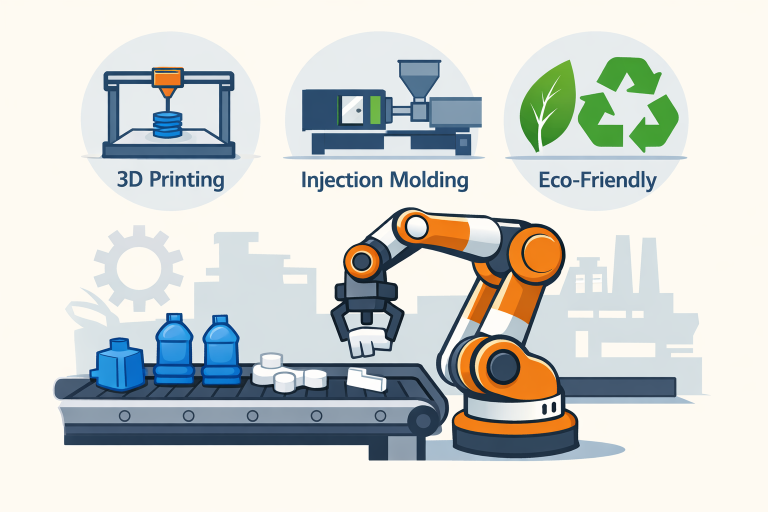
Automation and robotics are central to today’s custom plastic manufacturing facilities. Robotic arms, equipped with advanced sensors, perform tasks such as precise part removal, rapid assembly, and inspection. Their consistent operation reduces cycle times and error rates, helping manufacturers reach higher production volumes and tighter tolerances while minimizing human-related variability. “Lights-out” manufacturing, in which entire facilities run autonomously and continuously, is gaining popularity for its ability to dramatically increase productivity and reduce operational costs.
Advanced Injection Molding Techniques
Injection molding remains crucial, but its capabilities have expanded markedly through innovation. Multi-component injection molding combines multiple materials into a single part without additional steps, enabling the integration of features such as soft grips or seals in consumer and medical devices. Recent advancements include the use of highly engineered cooling channels, created via metal 3D printing, within the mold tooling. These custom channels enhance cooling efficiency and uniformity, not only shortening production cycles but also increasing part consistency and reducing warping or deformation in final products. The ability to rapidly prototype, test, and tweak molds before full-scale production minimizes risk and development costs.
3D Printing and Additive Manufacturing
3D printing, often referred to as additive manufacturing, has shifted from a prototyping niche to a full-fledged production process for custom plastic parts. Technologies such as continuous liquid interface production (CLIP) enable faster print speeds and can rival injection molding for medium-run jobs. Additive processes unleash new design possibilities, allowing for lightweight lattice structures or intricate custom geometries that would be impossible, overly expensive, or time-consuming with traditional machining. Companies increasingly rely on 3D printing for quick-turn parts in aerospace, medical, and electronics industries. This trend is likely to grow as the cost per part continues to decline, and more engineering-grade materials become available.
Sustainable Materials and Practices
Eco-conscious innovation is a priority for plastic part producers. Manufacturers are investing in biodegradable and compostable polymers, such as polylactic acid (PLA), alongside rigorous programs to increase recycled resin usage and develop circular production models. Additionally, lean manufacturing concepts, such as optimizing layout, standardizing processes, and reducing scrap, help minimize both environmental footprint and operating expense. These shifts are increasingly demanded by regulatory agencies, consumers, and supply chain partners committed to environmental responsibility.
Artificial Intelligence in Manufacturing
Artificial intelligence is transforming plastic manufacturing by enabling advanced software platforms to leverage large datasets and real-time sensor inputs. AI-driven analytics can detect subtle trends in process performance, predict customer and market needs, and automatically adjust production lines for optimal efficiency. This analytical power results in tighter control of material use, faster troubleshooting, and seamless scheduling, which is especially valuable when managing customized or highly variable orders. AI is also used to improve quality control through automated image recognition and to enable predictive maintenance of costly machinery, reducing downtime and operational disruptions.
Customization and Flexibility
The surge in demand for unique plastic components requires manufacturers to be flexible and responsive. Hybrid manufacturing solutions, where additive processes are combined with injection molding or CNC machining, are increasingly common, enabling fast, on-demand production with high repeatability. These technologies also help meet complex requirements in fields with tight regulatory standards, such as medical device prototyping or automotive safety parts. The ability to efficiently produce low-volume, high-quality custom batches allows manufacturers to serve a broader range of industries and adapt quickly to shifting consumer preferences.
Future Trends in Plastic Manufacturing
The next phase of innovation in plastic manufacturing is likely to come through the integration of smart materials and the evolution of processes that blend digital design, lean operations, and sustainability. Materials with adaptive properties, such as those that change color, stiffness, or thermal conductivity in response to external stimuli, are poised to transform applications in electronics, automotive parts, and medical devices. As connectivity improves and Industry 4.0 concepts mature, manufacturers will increasingly automate supply chains, optimize with data-driven insights, and bring new products to market faster.
In summary, the landscape of custom plastic manufacturing is rapidly evolving, bringing new levels of efficiency, environmental stewardship, and design complexity. Companies that invest in these innovations are positioned for significant competitive advantage and are better prepared to meet both customer expectations and the challenges of a global, technology-driven economy.