Winnipeg homes have always demanded practical thinking—seasonal storage needs, multi-use rooms, and the reality that a spare bedroom often becomes an office, guest room, or hobby space. That’s why “bed shopping” in Winnipeg increasingly looks like space planning rather than pure décor selection. The bed is no longer just a sleep surface; it’s a structural decision that affects how the room works during the day, how comfortable recovery feels at night, and how easily a home can adapt over time.
This shift is especially visible in households that are optimizing existing space rather than expanding it. When housing pressures rise, people tend to push more functionality into the same footprint—often by using vertical space, integrating storage, and choosing furniture systems that transform.
Rather than treating beds as a category, this guide breaks bed decisions into a framework: space constraints, mechanism reliability, long-term usability, and household change—the factors that determine whether a bed solution still feels smart five years after purchase.
Start With the Room’s Daytime Job, Not the Mattress
Before you evaluate Murphy beds, adjustable bases, or bed frames, define how the room must function between 8 a.m. and 10 p.m. That “daytime job” determines which bed types actually solve problems rather than introduce friction.
Common Winnipeg room patterns:
- Office-by-day / guest-room-by-night (condos, townhomes, smaller character homes)
- Shared children’s room where floor space matters as much as sleep space
- Primary bedroom with limited storage where under-bed capacity prevents clutter creep
- Multi-generational use where mobility and ease-of-entry become increasingly relevant
A bed that improves sleep but makes the room unlivable is a net loss. The goal is to select a system that removes friction: fewer furniture moves, fewer compromises, and fewer “we stopped using it that way” outcomes.
Murphy Beds: Where the Mechanism Is the Product
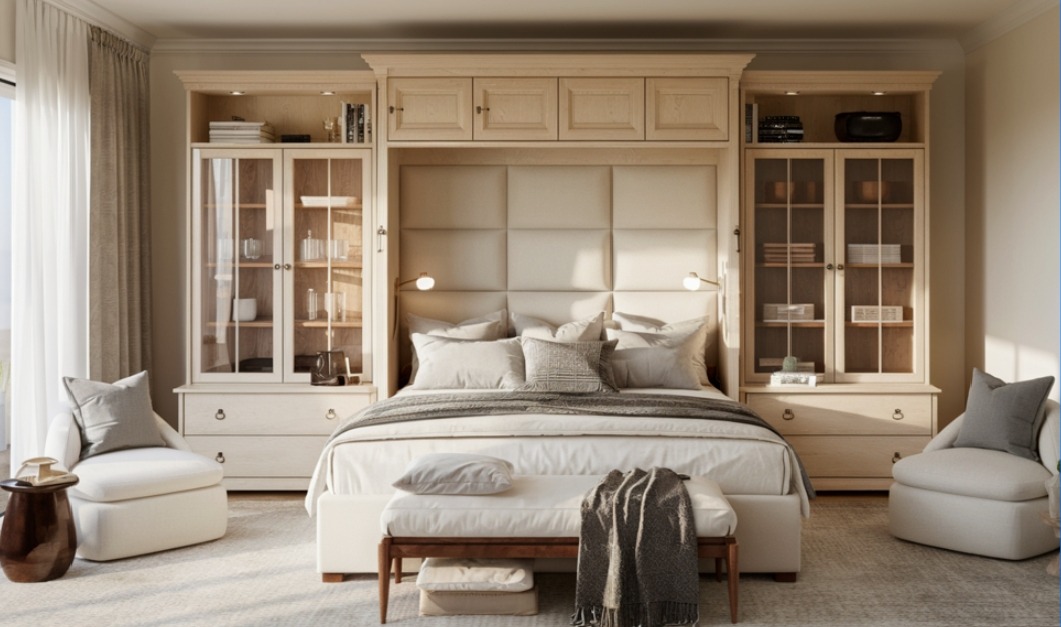
Murphy beds succeed when they’re engineered as systems, not when they’re treated like ordinary frames that happen to fold. The value is straightforward: floor space becomes usable for work, movement, or storage during the day—then converts back to sleep space at night.
Why they work particularly well in Winnipeg layouts:
- Older homes often have smaller secondary bedrooms that struggle to support both office furniture and a permanent bed.
- Condos and secondary suites frequently prioritize open circulation, making “bed always out” a design constraint.
- Guest-space usage is intermittent; storing the bed protects the room’s daily function.
But the biggest failure mode is also predictable: a Murphy bed that’s difficult to operate becomes permanently down, eliminating the entire premise. That’s why you evaluate:
- lift smoothness over repeated cycles
- cabinet alignment and racking resistance
- hardware quality and serviceability
- mattress compatibility and weight range
- anchoring requirements and wall structure realities
For historical context on why Murphy beds emerged and why they keep returning during density cycles, the Smithsonian’s coverage is a solid non-commercial reference: Curator finds Murphy beds’ place in American history.
Bunk Beds and Vertical Sleep: Maximizing Floor Space Without Compromising Safety
Bunk beds aren’t just for kids anymore; they’re increasingly a space strategy. The benefits are straightforward: floor area becomes usable for desks, storage, or play—critical in shared rooms and smaller homes.
But bunks have a higher structural bar than standard frames because they experience:
- dynamic loads (climbing, shifting weight, “kid physics”)
- higher fall-risk environments
- greater joint stress due to vertical leverage
Practical criteria that matter more than aesthetics:
- guardrail height relative to mattress thickness
- ladder stability and tread design
- lateral wobble resistance (shake test is meaningful)
- long-term joint tightening needs
- whether the design can separate into two beds later
Adjustable Beds: Comfort Is the Baseline; Usability Is the Differentiator
Adjustable bases are often discussed in terms of health benefits, but the real adoption driver is simpler: people keep them because they’re usable daily. The best systems reduce friction—reading comfortably, shifting positions without stacking pillows, finding a low-pressure posture after long desk days.
In Winnipeg households, adjustable beds tend to work best when:
- the controls are intuitive and reliable
- the motor is quiet enough for shared sleep spaces
- the mattress is truly compatible (flex + edge integrity)
the frame height and entry/exit ergonomics are appropriate
The most common failure mode is a system that’s “feature rich” but annoying to use, leading to permanent flat positioning. When that happens, the adjustable base becomes dead weight—literally and financially.
The Best Bed Choice Is the One That Keeps Working
For Winnipeg residents translating room dimensions, support requirements, and system compatibility into a workable bedroom setup, Best Sleep Centre represents one locally established option among broader furniture retailers such as IKEA, Leon’s, or The Brick—illustrating how different bed systems are configured and supported in real residential spaces without positioning any single provider as a default choice.
The safest way to choose beds in Winnipeg is to treat the purchase as an operational decision, not a trend decision. The best outcomes come from matching the room’s daytime needs, selecting mechanisms and frames that remain stable over years of use, and choosing setups that reduce friction rather than create it.
When a Murphy bed operates smoothly after hundreds of cycles, when an adjustable base is actually used daily, and when a frame stays silent and stable through seasonal changes, the bed fades into the background—doing its job without demanding attention. That’s the real benchmark for a space-efficient sleep solution that lasts.